How to reduce the impedance factor of the circuit board
The circuit performance provided by the printed circuit board must be able to prevent reflections during signal transmission, keep the signal intact, reduce transmission loss, and play the role of matching impedance so that a complete, reliable, accurate, interference-free, and noise-free transmission signal can be obtained. The relationship between characteristic impedance and substrate material (copper clad laminate) is very close, so the selection of substrate material is very important in circuit board design.
The main factors affecting the characteristic impedance are:
1. The dielectric constant of PCB circuit board materials and its influence Impedance circuit board diagram Impedance circuit board diagram
Generally, the average value can be used to meet the requirements. The transmission speed of a signal in a dielectric material will decrease as the dielectric constant increases. Therefore, to obtain a high signal transmission speed, the dielectric constant of the material must be reduced. At the same time, to obtain a high transmission speed, a high characteristic resistance value must be used, and a high characteristic resistance value must use a low dielectric constant material.
2. The influence of wire width and thickness
Variations in conductor width allowed in circuit board production can cause large variations in impedance values. The width of the wire is determined by the designer according to various design requirements. It must not only meet the requirements of the current carrying capacity and temperature rise of the wire, but also obtain the desired impedance value.
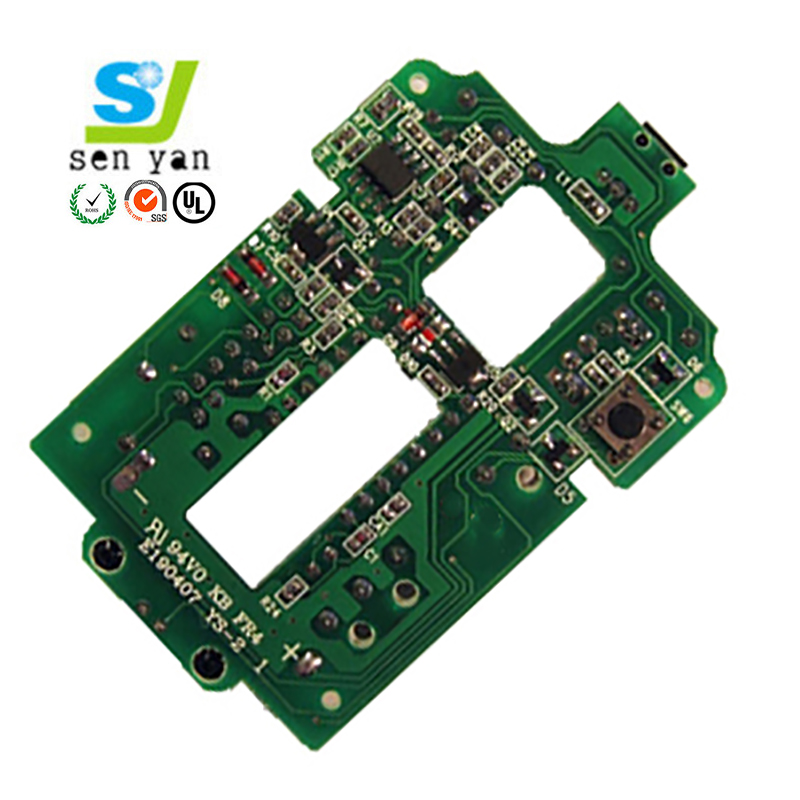
This requires that the circuit board manufacturer should ensure that the line width meets the design requirements during production, and make the change within the tolerance range to meet the impedance requirements. The thickness of the wire is also determined according to the required current carrying capacity of the conductor and the allowable temperature rise. In order to meet the requirements of use in production, the average thickness of the coating is generally 25um. The thickness of the wire is equal to the thickness of the copper foil plus the thickness of the plating. It should be noted that the surface of the wire must be clean before electroplating, and there should be no residue and black oil on the board, which will cause the copper to not be plated during electroplating, so that the local wire thickness will change and affect the characteristic impedance value. In addition, in the process of brushing the board, be careful not to change the thickness of the wire and cause the impedance value to change.
3. The influence of medium thickness
The characteristic impedance of the circuit board is proportional to the natural logarithm of the dielectric thickness, so it can be seen that the thicker the dielectric thickness, the greater its impedance, so the dielectric thickness is another main factor affecting the characteristic resistance. Because the wire width and the dielectric constant of the PCB circuit board material have been determined before production, the wire thickness process requirements can also be used as a fixed value, so controlling the lamination thickness (medium thickness) is the main means of controlling the characteristic impedance in production. In the actual production process, the allowable variation in the lamination thickness of each layer of the circuit board will cause a large change in the impedance value. In actual production, different types of prepregs are the insulating medium, and the thickness of the insulating medium is determined according to the number of prepregs.
Under the same dielectric thickness and material, it has a higher characteristic impedance value, which is generally 20~40 times larger. Therefore, the design of microstrip line structure is mostly used for high-frequency and high-speed digital signal transmission. At the same time, the characteristic impedance value will increase with the increase of the dielectric thickness. Therefore, for high-frequency lines with strictly controlled characteristic impedance values, strict requirements should be placed on the error of the dielectric thickness of the copper clad laminate. Generally speaking, the variation of the dielectric thickness does not exceed 10%. For multi-layer boards, the thickness of the medium is still a processing factor; especially closely related to multi-layer lamination processing, therefore, it should also be strictly controlled.